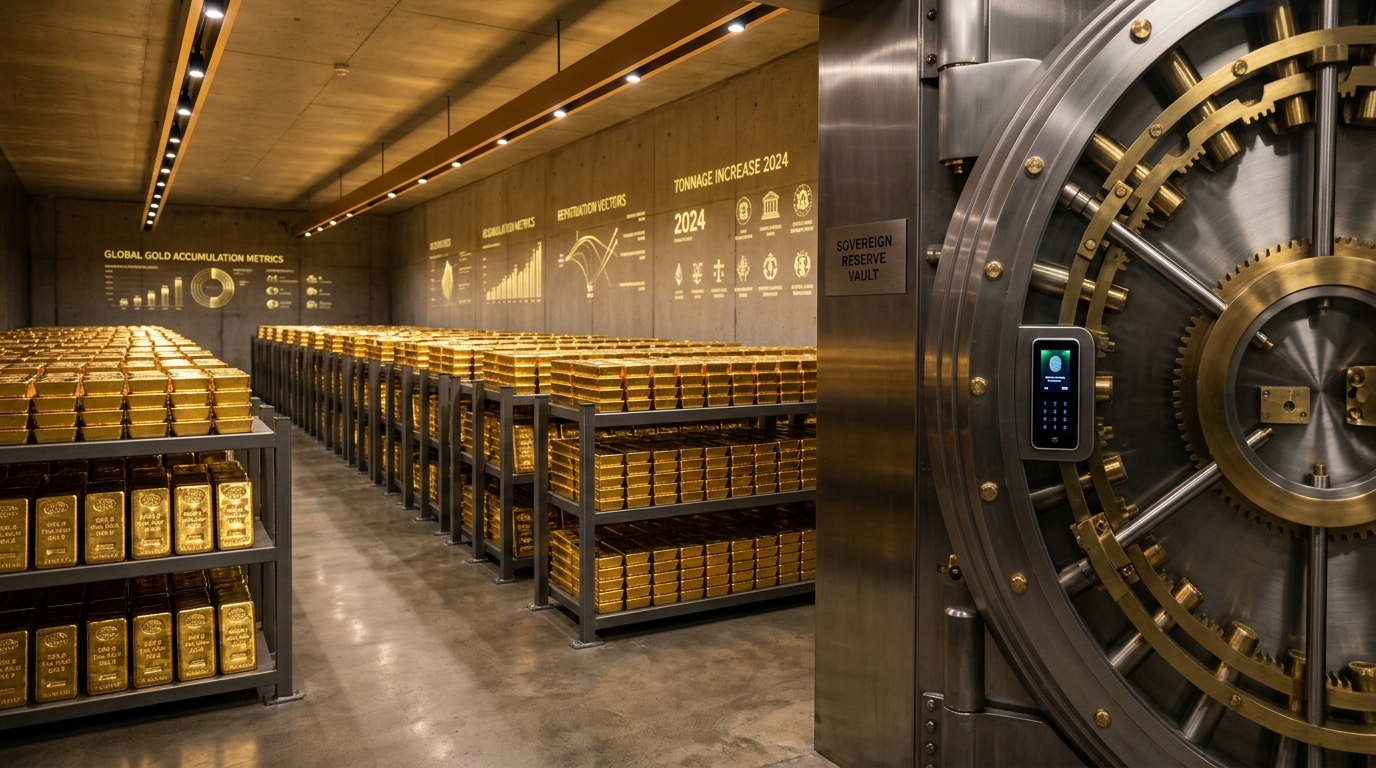
The Awakening of the King of Metals: The Return to Counterparty-Free Collateral
For over four decades, mainstream economic doctrine taught that physical gold was a "barbarous relic" — a dismissive phrase coined by John Maynard Keynes in the 1920s to describe an inert metal that yields no interest, incurs carrying costs, and holds no functional purpose in an enlightened monetary order managed by technocratic central banks.
Yet inside the high-security underground vaults stretching from Beijing to Warsaw, from New Delhi to Singapore, that academic playbook has been decisively discarded. Over the past three years, sovereign monetary authorities have accumulated over 1,000 net metric tons of physical gold bullion per year — the most aggressive and coordinated pace of state purchases recorded since the Second World War and the 1944 Bretton Woods accords.
“Gold is money; everything else is credit. When the United States and Europe demonstrated that credit instruments can be erased by executive decree, central banks rediscovered the only currency that cannot be printed by any treasury or frozen by any keystroke.”
The underlying driver of this relentless gold rush is not short-term inflation hedging, but an unyielding geopolitical reality: in a world fractured by great-power rivalry, foreign exchange reserves denominated in foreign fiat paper are not sovereign assets, but prospective hostages of whoever commands the international clearing clearinghouses.
---
The Great Repatriation: Why Nations Are Pulling Bullion Out of New York and London
Historically, the vast majority of official central bank gold remained deposited in the subterranean vaults of the Federal Reserve Bank of New York in Lower Manhattan or within the subterranean vaults of the Bank of England in London. The rationale was purely pragmatic: keeping bullion in the two premier financial hubs facilitated leasing liquidity, foreign exchange swaps, and institutional clearing.
That multi-century covenant of institutional trust collapsed in February 2022. When Russian sovereign foreign exchange reserves were frozen overnight by the G7, central bank governors across non-aligned nations faced an existential question: "If our diplomatic posture ever diverges from Washington or London, will our physical bullion actually be returned?".
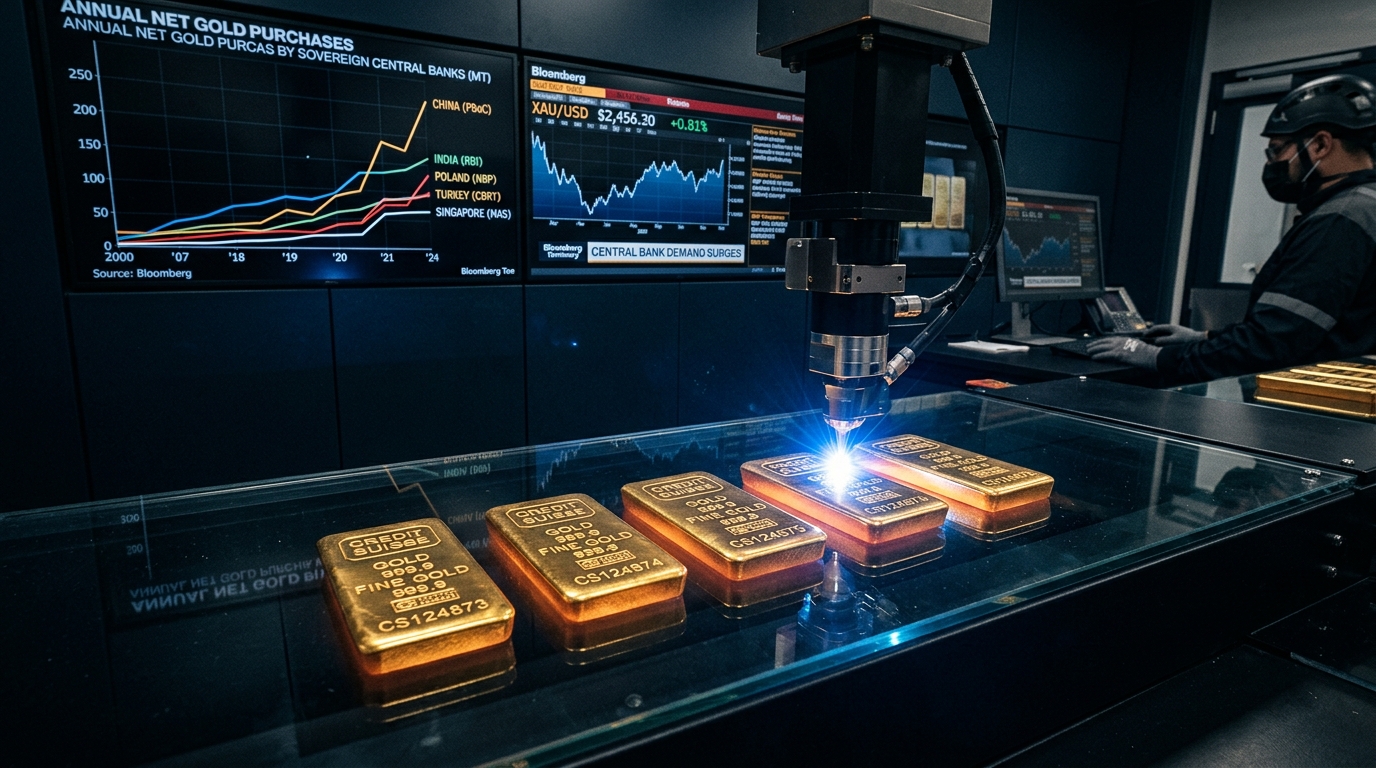
The practical response has been the largest sovereign physical gold repatriation movement in modern history:
Annual Net Central Bank Gold Purchases (Metric Tons)
Physical sovereign accumulation trajectory before and after 2022
---
Ending the Fiat Illusion and the Basel III Regulatory Pivot
Beyond geopolitical weaponization, a silent regulatory overhaul accelerated gold's return to the core of the global banking system: the Basel III banking accords.
Under these revised international bank solvency standards: 1. Physical allocated gold stored in sovereign and commercial bank vaults was reclassified from a Tier 3 risky asset to Tier 1 Regulatory Capital — carrying a zero risk-weight, legally equivalent in institutional quality to cash and sovereign government bonds. 2. Conversely, synthetic "paper gold" (unallocated derivatives traded on COMEX and the LBMA) was subjected to stringent structural capital charges for bullion banks.
This regulatory realignment forced global Tier 1 institutions to close out naked paper shorts and demand physical bar allocation, unleashing structural tightness across wholesale physical markets.
---
Toward a New Monetary Settlement: Tangible Asset Collateral
The most consequential macroeconomic implication of this gold rush is the slow, inexorable unwinding of the pure fiat experiment inaugurated in August 1971. For half a century, the global economy operated under the historical anomaly of using the national currency of a single debtor nation as the universal reserve asset — an asset whose purchasing power rested solely on the fiscal promises of Washington.
Today, confronting a US federal debt expanding by $1 trillion every 100 days and net interest outlays exceeding the entire Pentagon defense budget, central banks across Eurasia and the Global South are anchoring their balance sheets in the only asset possessing an unblemished 5,000-year track record against sovereign default and monetary debasement.
The structured dialogues within the expanded BRICS+ grouping to introduce a multilateral settlement unit (The Unit) anchored by a basket comprising 40% physical gold and 60% participating member currencies are not theoretical abstractions: they are the institutional codification of an asset rotation already visible on central bank balance sheets worldwide.
---
Conclusion: The Unforgiving Mathematics of History
Empires ascend with robust currencies backed by productive capacity and tangible collateral; they decline when they substitute industrial discipline with unfettered fiat expansion and exponential debt compounding.
The sovereign rush for gold is not an exercise in historical nostalgia; it is a tactical defense protocol for the emerging international order. Monetary authorities actively repatriating tons of physical gold to their domestic territory understand what history has repeatedly validated: when fiat paper promises fracture under the weight of geopolitical conflict and fiscal overreach, only tangible assets retain the sovereign power to settle energy trade, command capital, and preserve national independence.
---
Primary Sources & International Regulatory Documentation
- "".
- "".
- "".
- "".