In This Essay
The Fallacy of Productive Suffering: Confusing Manual Drudgery with Intellectual Prowess
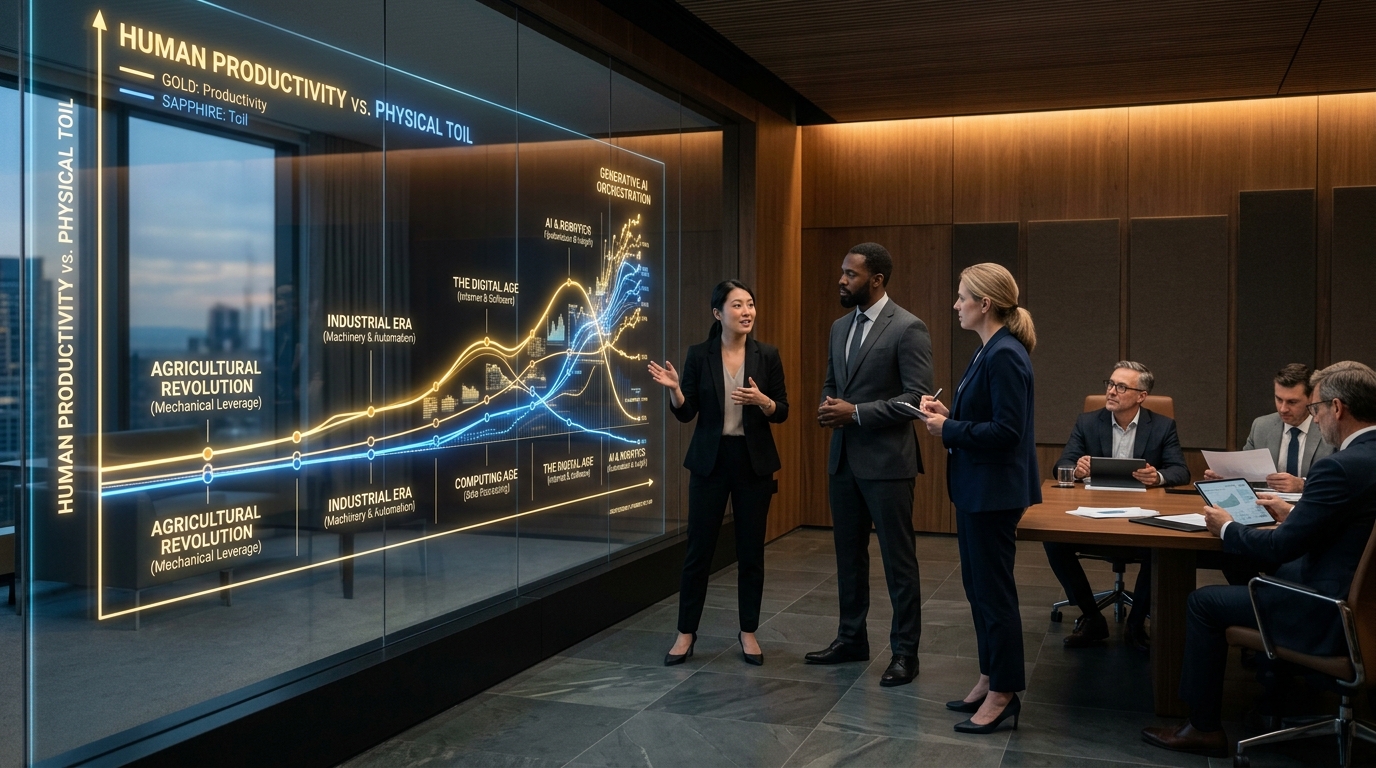
Across nearly all contemporary corporate cultures, a pervasive and silent psychological bias endures: the unspoken belief that the true value of intellectual work is directly proportional to the amount of physical pain, visual exhaustion, and sheer hours of mechanical friction expended to produce it. Under this distorted lens, the professional who toils for fourteen uninterrupted hours manually typing reports, styling spreadsheet cells one by one, or hunting legal precedents through dust-covered paper files is venerated as "virtuous and dedicated." Meanwhile, the professional who orchestrates an advanced artificial intelligence model to synthesize that exact same body of knowledge in forty minutes is viewed with suspicion — as if they were cutting corners, exhibiting laziness, or demonstrating cognitive deficiency.
This reaction is neither new nor unprecedented. It represents the modern manifestation of a millennia-old technophobia: a visceral resistance to any innovation that strips away mechanical drag so the human intellect can operate at higher tiers of strategic abstraction.
“Give me a lever long enough and a fulcrum on which to place it, and I shall move the world. Artificial intelligence does not supplant the human mind; it is Archimedes' lever for human intellect.”
The history of human civilization is not an ode to immutable manual toil; it is the grand chronicle of the systematic externalization of human intelligence through artificial tools. Those who dismiss AI today commit the very same error as the medieval scribes who boycotted the printing press, or the 20th-century bookkeepers who insisted that digital spreadsheets would destroy arithmetic literacy.
---
The Genealogy of the Extended Mind: Every Tool Has Always Been Artificial Intelligence
Human biological intelligence is formidable yet physically constrained: our short-term working memory holds merely a handful of simultaneous data chunks, and our brain operates within a metabolic envelope of roughly twenty watts. To transcend these biological boundaries and erect global civilizations, humanity has continuously engineered external cognitive prosthetics — technical systems designed to record, calculate, and transmit data outside the biological skull.
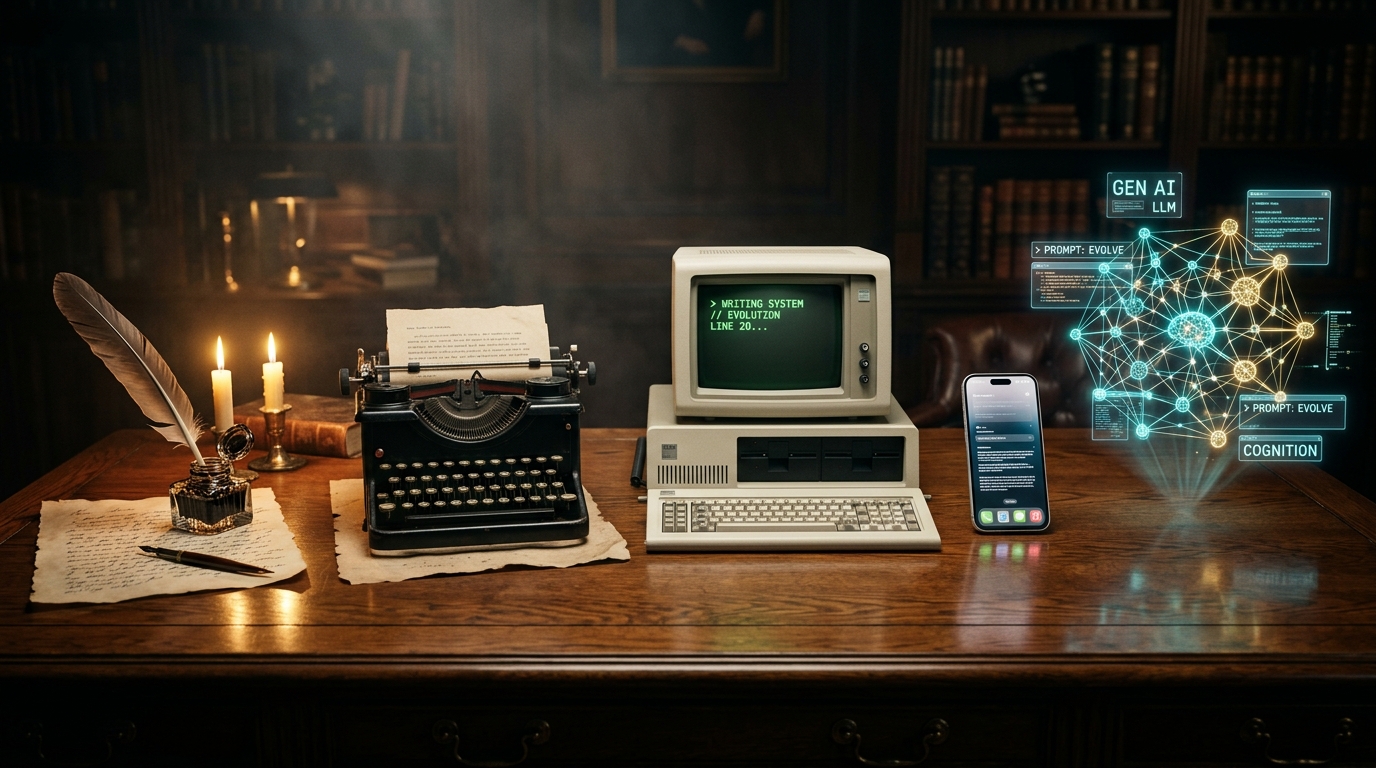
The historical continuum connecting humanity's earliest recording implements to contemporary artificial intelligence is unbroken, coherent, and cumulative:
1. The Quill and Papyrus (The First External Memory)
Before written script, knowledge transmission was fragile, tethered strictly to the fallible oral memory of tribal elders. When the Sumerians etched cuneiform into wet clay and Egyptians dipped reeds onto papyrus, contemporary traditionalists decried the loss of mnemonic purity. In Plato's celebrated dialogue Phaedrus, Socrates famously argued that writing would introduce forgetfulness into learners' souls, creating the mere conceit of wisdom without genuine internal understanding. Yet writing was humanity's inaugural "artificial intelligence": it decoupled ideas from biological mortality, enabling thought to transcend millennia.
2. Gutenberg's Movable Type Printing Press (The Multiplication of Thought)
In the 15th century, duplicating a single manuscript demanded months of grueling manual copying by monastic scribes in damp cloisters. When Johannes Gutenberg unveiled the movable type press, scholastic theologians accused the machine of mechanizing the sacred and degrading intellectual virtue. The press did not enfeeble human thought; it catalyzed the Renaissance, the Scientific Revolution, and the economic foundations of the modern world.
3. The Typewriter and the Ballpoint Pen
Transitioning from inkpot dip pens to portable ballpoints and mechanical typewriters provoked outrage among classical calligraphers, who lamented the loss of "manual soul." In reality, typewriters liberated human communication from hand fatigue, speeding government, corporate, and diplomatic discourse by orders of magnitude.
4. The Personal Computer and the Electronic Spreadsheet
Throughout the 1970s and 1980s, corporate accountants and financial analysts manually maintained ledger sheets, painstakingly adding columns of thousands of numbers with pencils and erasers. The arrival of VisiCalc and Lotus 1-2-3 (the forebears of Microsoft Excel) ignited apocalyptic forecasts: "accounting is dead", "nobody will know how to add anymore". In truth, demand for accountants and financial analysts exploded. Emancipated from mechanical arithmetic, these professionals shifted upstream into scenario modeling, strategic taxation, risk engineering, and corporate valuation.
5. The Smartphone and Ubiquitous Connectivity
Over the past decade, smartphones consolidated the totality of human knowledge into a palm-sized glass slab. It computes optimal routes in real time, translates foreign idioms instantaneously, and synchronizes international bank balances. No patient accuses a surgeon of incompetence for referencing a peer-reviewed surgical study on a mobile screen rather than walking to a brick-and-mortar medical library.
---
What is Artificial Intelligence, Really?
Generative artificial intelligence is neither a mystical entity that "thinks on your behalf" nor an indictment of human cognitive capacity. It is simply the next evolutionary milestone on this secular continuum: a high-velocity probabilistic engine trained to recognize deep patterns across human language, symbolic mathematics, and operational logic.
Knowledge Worker Time Allocation Shift (%)
Migration from mechanical routine compilation toward high-order strategic judgment
When an experienced analyst leverages AI to dissect a corporate balance sheet, generate a preliminary contract draft, or debug software architectures, they are reducing the marginal cost of the first rough draft to near zero.
The mechanical chore of assembling preliminary syntax and structure is absorbed by the neural engine. What remains in human hands? Exactly what is most noble, complex, and irreplaceable: forensic verification (*grounding*), ethical stewardship, adversarial testing, and final executive authority.
---
The Paradox of the Qualified User: AI Does Not Rescue Incompetence
The most widespread criticism voiced by AI skeptics is the assumption that "anyone without domain training can now fabricate elite work simply by clicking a button". This claim betrays a profound misunderstanding of how intelligence architectures actually function.
In real-world professional environments, the exact reverse holds true: artificial intelligence operates as a symmetrical multiplier of user competence.
1. In the Hands of an Amateur: Artificial intelligence produces industrial-grade mediocrity. An untrained user cannot formulate nuanced problems, blithely accepts mathematical hallucinations, fails to spot regulatory non-compliance, and outputs bland generalities that collapse under five minutes of executive scrutiny. 2. In the Hands of a Senior Domain Master: Artificial intelligence functions like an elite taskforce of thirty tireless junior researchers. The master knows precisely what constraints to set, performs adversarial stress-testing, injects strict statutory guardrails (such as IFRS standards or complex tax codes), and audits every line with forensic rigor.
“AI is like a concert grand piano: it produces no sublime music on its own. In the hands of someone who cannot read sheet music, it produces chaotic noise; in the hands of a master composer, it delivers symphonies with unprecedented velocity.”
Mastering artificial intelligence does not demand less study; it demands far greater conceptual depth. To catch a subtle legal or accounting error hallucinated by an AI, a professional must understand the underlying doctrine far more intimately than someone merely copying boilerplate examples from an old textbook.
---
The New Work Ethic: Value Resides in Outcomes, Not in Meaningless Suffering
Modern civilization must shed the archaic dogma that confuses painful exertion with valuable labor. Digging a foundation ditch with a teaspoon over several weeks consumes immense physical energy, yet produces negligible societal value compared to a licensed operator who commands a modern excavator in fifteen minutes.
In intellectual domains, the parallel is identical:
Artificial intelligence does not diminish professional stature; it emancipates the worker from typing serfdom. A surgeon operating with a sub-millimeter robotic arm is no less a physician than one using bone saws in the 19th century — they are infinitely more effective, save more lives, and commit fewer errors.
---
The Future Belongs to the Masters of Orchestration
Every technological inflection point in history sorted professionals into two distinct camps: 1. Those who clung to the legacy tool as if it defined their self-worth, resisting the paradigm until obsolete; 2. Those who recognized that tools are temporary vehicles toward a higher purpose: the excellence and impact of the ultimate outcome.
Those who wrote with quills were not writers because of bird feathers, but because of the brilliance of their prose. Those who typed on mechanical typewriters were not journalists because of metal keys, but because of their dedication to truth. Those who orchestrate artificial intelligence today are no less thinkers for leveraging algorithms — they are the legitimate heirs of a species that learned to shape external matter to amplify the frontiers of its own consciousness.
The dawn of artificial intelligence is not the twilight of human cognition. It marks the long-awaited era where humanity can finally delegate robotic chores to silicon, liberating human intellect for what is uniquely and irreducibly human: radical creativity, ethical stewardship, genuine empathy, and visionary leadership.
---