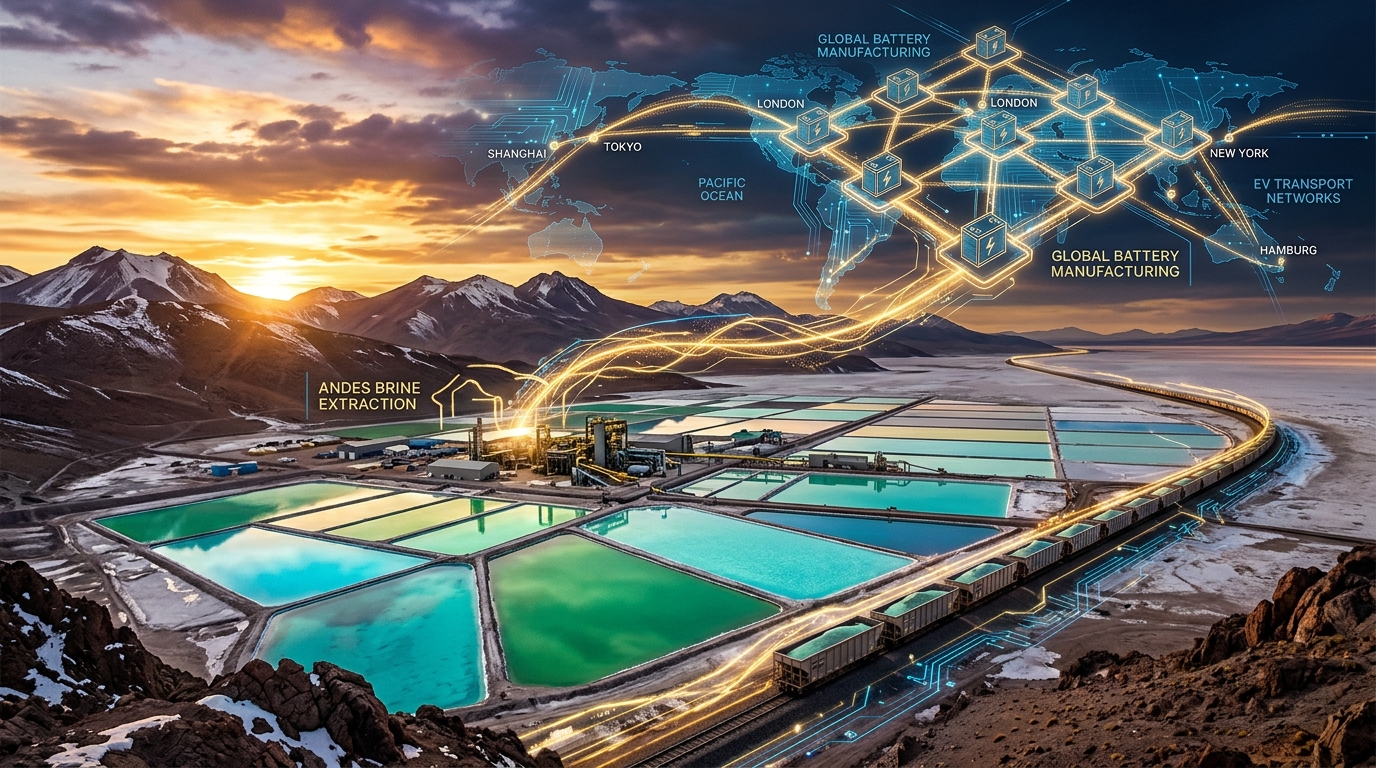
The New Oil of the 21st Century: From Hydrocarbon Diplomacy to Electron Sovereignty
Throughout the 20th century, global power was dictated by control over petroleum basins, pipelines, and maritime chokepoints through which crude oil flowed. Superpower diplomacy, proxy wars in the Middle East, and the hegemony of the petrodollar were engineered around fossil combustion. In the 21st century, however, a silent and tectonic transition has overhauled international security: the geopolitics of hydrocarbons has given way to the war for critical mineral sovereignty.
Lithium, cobalt, nickel, neodymium, dysprosium, and gallium are no longer mere entries on the periodic table; they have become the backbone of national survival. Without these elements, there are no electric vehicle battery packs, no offshore wind turbines, no artificial intelligence data centers, no advanced semiconductor wafers, no active radar arrays, and no hypersonic missile guidance systems.
“Whoever controlled oil in the last century governed transportation and heavy industry; whoever controls critical minerals and rare earths today governs the digital frontier, the energy grid, and the advanced weaponry of the 21st century.”
The great illusion of the Western world was believing that globalization and market forces would guarantee the friction-free flow of these strategic inputs. While Western capitals prioritized financialization and regulatory outsourcing, Beijing executed with mathematical precision a four-decade state-directed master plan: commanding not merely geological extraction, but the most complex, capital-intensive, and strategically lethal tier — the monopoly over chemical refining and metallurgical separation.
---
Anatomy of the Chokepoint: Extraction vs. Chemical Refining Monopoly
There is a fundamental distinction often overlooked by financial analysts between where a mineral is buried and where it becomes industrially usable. A metric ton of raw spodumene extracted in Australia or salty brine pumped from Andean salt flats is useless to a semiconductor or battery gigafactory until it is purified to 99.99% battery grade.
It is precisely at this processing nexus that the planetary bottleneck resides:
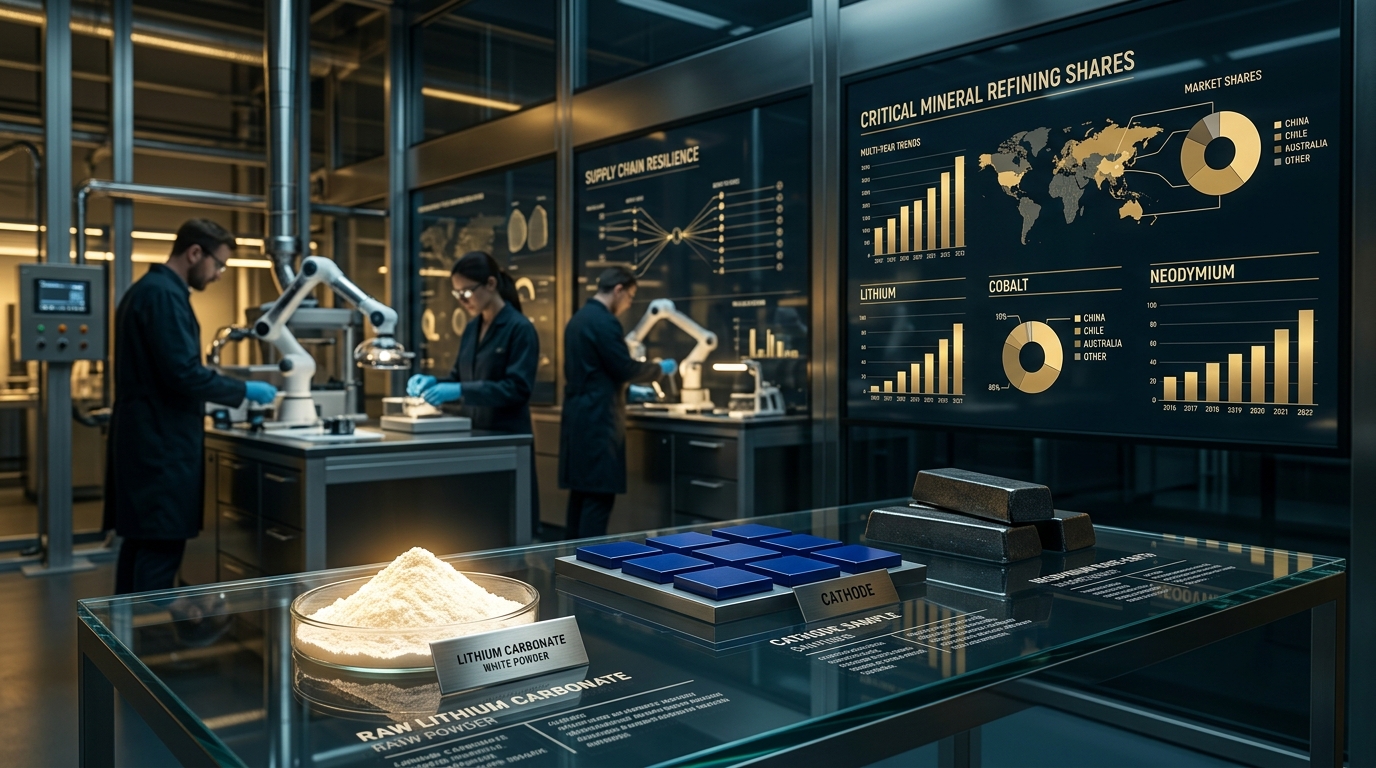
China does not need to possess every mine within its domestic borders to hold the global economy in check. By controlling 68% of lithium chemical refining, 72% of cobalt refining, and an overwhelming 90% of heavy rare earth separation, Beijing has transformed Western resource reliance into an existential exposure that surpasses, in systemic magnitude, the 1973 OPEC oil embargo.
Share of Global Critical Mineral Refining (%)
Industrial concentration of chemical purification and cathode processing
When Chinese authorities implemented export license restrictions on gallium, germanium, and synthetic battery graphite for defense applications in 2023 and 2024, replacement costs across NATO aerospace supply chains surged immediately, exposing the structural vulnerability of Western just-in-time logistics.
---
The Lithium Triangle and the South American Dilemma
In South America, the high-altitude Andean plateau holds over 50% of the planet's identified lithium brine resources within the famed Lithium Triangle — encompassing the Salar de Atacama (Chile), Salar de Uyuni (Bolivia), and Salar del Hombre Muerto (Argentina).
Yet each of these three states has pursued a starkly divergent doctrine, mirroring the continent's historical ideological fissures:
The historical trap confronting South American nations is the reenactment of the extractive colonial commodity cycle: exporting unprocessed brine and basic salts while re-importing high-margin battery modules, energy storage systems, and microchips fabricated in East Asia and Europe.
---
The Western Counteroffensive: The Inflation Reduction Act and Industrial Protectionism
Faced with the alarming reality that their automotive, aerospace, and defense industrial bases depend on export licenses approved in Beijing, Washington and Brussels discarded classical free-market orthodoxies and entered an era of defensive state capitalism.
In the United States, the Inflation Reduction Act (IRA) and invocations of Title III of the Defense Production Act marshaled hundreds of billions of dollars in conditional subsidies: consumer tax credits for electric vehicles now mandate that an escalating proportion of critical minerals be sourced or refined within North America or designated free-trade agreement partners.
However, permitting and commissioning a commercial hard-rock mine and metallurgical refinery in Western jurisdictions spans between 7 and 14 years due to stringent environmental review protocols, litigation delays, and acute domestic shortages of experienced chemical process engineers. Until these domestic and friendly facilities achieve scale in the 2030s, any geopolitical flashpoint over Taiwan or maritime choke points in the Indo-Pacific could freeze Western advanced manufacturing within weeks.
---
Conclusion: Nations That Command Matter Rule the Century
The green energy transition and technological acceleration have not decoupled civilization from the earth; on the contrary, they have made society vastly more dependent on hyper-concentrated, geographically volatile geological resources. The promise of a weightless, purely digital economy has collided with physical chemistry: decarbonizing and electrifying the world requires extracting and refining more mineral tonnage than at any prior juncture in human history.
The powers that recognized this paradigm decades ago and secured dominance over chemical refining have already scripted the rules of the emergent international order. For resource-rich developing nations, the 21st century provides an unforgiving and narrow window: either construct sovereign domestic refining complexes that capture high technological value, or remain permanent spectators at the geopolitical chessboard of the industrial superpowers.
---
Primary Sources & Official Documentation
- "".
- "".
- "".
- "".