
In This Essay
From Surface Geopolitics to Deep Infrastructure Architecture
Throughout the twentieth century, classical grand strategy—from Halford Mackinder to Nicholas Spykman and Zbigniew Brzezinski—viewed global power as a two-dimensional surface chessboard: control over the Eurasian continental landmass (Heartland) versus dominance of the coastal maritime fringes (Rimland). By the second quarter of the twenty-first century, however, this flat cartography has become obsolete. True national sovereignty is no longer contested solely on the visible surface of oceans and continents; it is decided at the three-dimensional convergence of three interdependent critical infrastructures:
1. The Physical Data Layer (The Ocean Abyss): The submarine fiber-optic cable network carrying over 97% of global internet traffic, algorithmic stock exchange orders, and interbank messaging. 2. The Material & Logistics Layer (Subsoil and Rail): Transcontinental corridors for extracting, refining, and transporting critical minerals—whose geopolitical epicenter in the South Atlantic is today the Lobito Corridor, linking Angola to the copper and cobalt belt of the Democratic Republic of the Congo (DRC) and Zambia. 3. The Monetary Settlement Layer (The Cryptographic Protocol): The structural transition away from the Western correspondent banking system (SWIFT/CHIPS) toward atomic settlement platforms using wholesale Central Bank Digital Currencies (Multi-CBDC), spearheaded by Project mBridge.
“Contemporary sovereignty rests upon an indivisible triad: whoever controls the optical glass beneath the oceans holds the information; whoever controls the railway and chemical metallurgy holds the matter; and whoever controls the distributed ledger among Central Banks holds the currency. Losing any one of these three links reduces a nation to a modern colony.”
Examining these three fronts in isolation yields only fragments. A batch of critical minerals mined in Kolwezi (DRC) and loaded at the Port of Lobito (Angola) has its reference price discovered via futures contracts transmitted through subsea cables across the Atlantic and its commercial invoice settled on digital clearing ledgers. This essay dissects the New Triad of Global Power through the integrated lens of computer network engineering, sovereign financial controllership, and resource geopolitics.
---
Act I — The Silent Abyss: Subsea Cable Geopolitics and the Fragility of the Cloud
A persistent semantic illusion cultivated by the technology industry suggests that the digital economy resides in an ethereal, weightless "cloud" floating in the sky. From the standpoint of computer network engineering, physical reality dictates the exact opposite: the "cloud" is not in the sky; it lies buried in the abyssal mud of the ocean floor, encased inside polyethylene, copper, and glass tubes no thicker than a garden hose.
While Low Earth Orbit (LEO) satellite constellations such as Starlink play an important tactical role for remote regions and mobile military theatres, optical physics remains unforgiving: the bandwidth of a single modern submarine cable equipped with Erbium-Doped Fiber Amplifiers (EDFA) and Dense Wavelength Division Multiplexing (DWDM) exceeds the combined capacity of thousands of satellites by orders of magnitude, at a fraction of the latency.
The Systemic Vulnerability of US$ 10 Trillion Per Day
Roughly 550 active submarine cable systems, spanning over 1.4 million kilometers, sustain modern civilization. Through these hair-thin silica filaments flow more than US$ 10 trillion in daily financial transactions, CLS Bank foreign exchange settlements, ISO 20022 messages from SWIFT and CIPS, and encrypted diplomatic and military dispatches.
This physical backbone exhibits three critical geopolitical vulnerabilities:
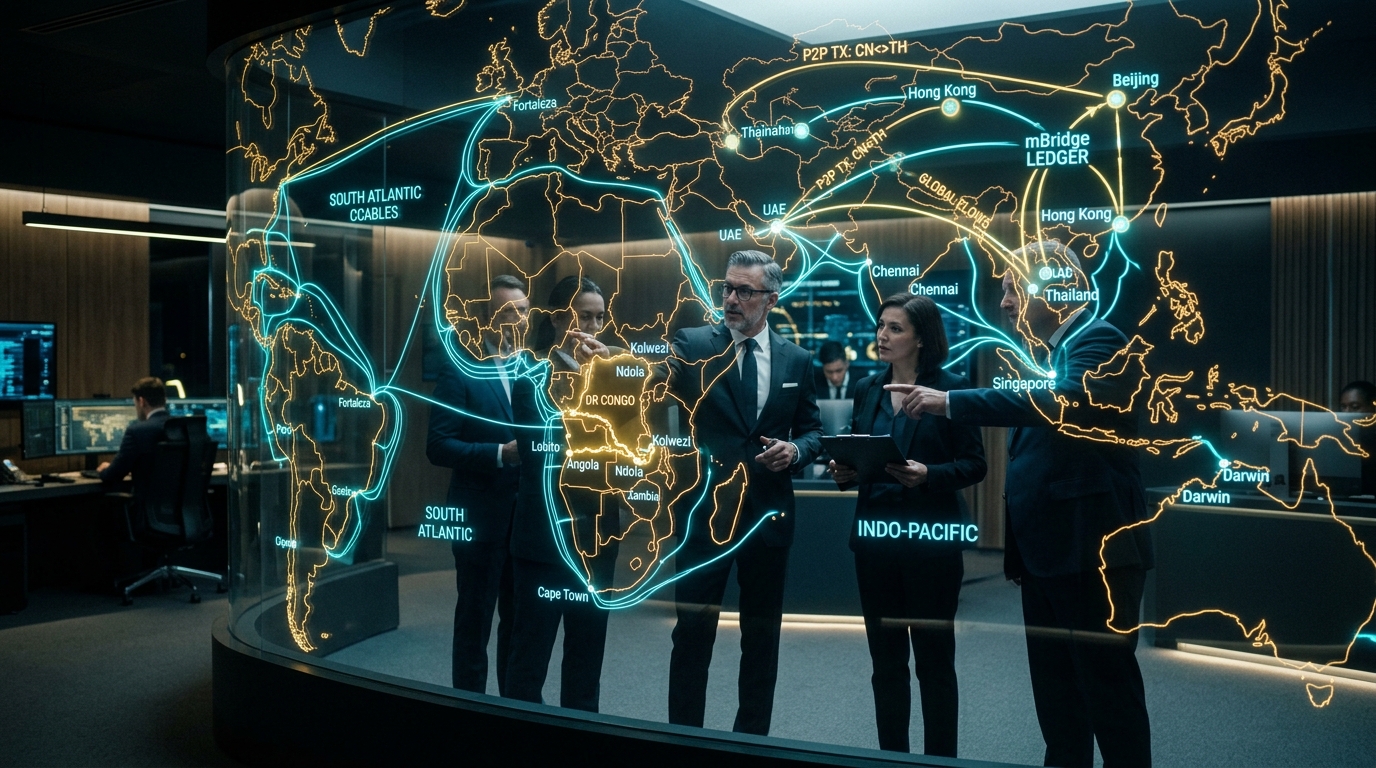
For the Global South—and specifically for the Angola – Brazil – Southern Africa axis—the SACS cable marked the first milestone in the digital decolonization of the South Atlantic: for the first time in telecommunications history, IP packets and financial telemetry could travel from Luanda to South America without mandatory routing or inspection through servers in Miami, New York, London, or Lisbon.
---
Act II — The Lobito Corridor and the Battle for the South Atlantic: Colonial Extraction or Sovereign Industrialization?
If subsea cables form the nervous system of the twenty-first-century economy, critical minerals (copper, cobalt, lithium, manganese, graphite, and rare earth elements) constitute its physical skeleton. Nowhere on Earth is this territorial competition more visible today than along the Lobito Corridor.
Stretching approximately 1,300 kilometers across Angolan territory via the historic Benguela Railway (CFB)—from the Atlantic Port of Lobito to the Luau border—and connecting directly into the mining rail network of Kolwezi (Lualaba Province, DRC) and the Zambian Copperbelt, the Lobito Corridor has become the flagship geoeconomic initiative of the West (backed by the G7's Partnership for Global Infrastructure and Investment — PGII, the United States, and the European Union) to counterbalance two decades of Chinese Belt and Road Initiative dominance across Africa.
The Logistics Math and the African Sovereignty Dilemma
From a purely logistical and operational standpoint, the efficiency gains of the Lobito Corridor are transformative:
Yet, through the rigorous lens of economic controllership and sovereign development, we must pose the question that diplomatic communiqués from Brussels, Washington, and Beijing routinely sidestep: Who benefits from an ultra-modern railway if it merely accelerates the export of raw, unrefined rock without local value addition?
| Geoeconomic Model | Operational Structure in the Corridor | Value Retained in Host Nation (% GDP) | Trade Balance & Sovereignty Impact | | :--- | :--- | :--- | :--- | | Pure Extractive Transit (19th/20th Century Model) | Railway connects mine directly to bulk carrier; ore leaves raw or semi-concentrated | 10% to 15% (Basic mining royalties and port handling fees) | Perpetuates external dependency; nation later imports finished batteries and tech at 10x the price | | Midstream Beneficiation & Industrialization (Indonesian Model) | Contractual mandate for chemical refineries, smelters, and special economic zones along the rail line | 45% to 65% (Chemical metallurgy, engineering jobs, corporate tax base) | Real technology transfer, supply chain deepening, and structural trade surplus | | Multipolar Sovereign Integration (2026–2035 Diamond Standard) | Local refining + Central Plateau agro-industry + Settlement in sovereign currencies/gold | > 70% (Command over benchmark pricing, logistics, energy, and clearing) | Transforms a transit corridor into an autonomous continental industrial engine |
The economic history of Africa and Latin America is a graveyard of colonial railways built in a straight line from inland mines to coastal ports, failing to integrate domestic markets or leave behind a single chemical processing plant.
For Angola, the DRC, and Zambia to convert the Lobito Corridor into an instrument of genuine sovereignty, three non-negotiable conditions must be enforced: 1. Local Metallurgical and Chemical Refining: Leveraging clean, abundant hydroelectric power (such as Angola's Middle Kwanza basin—Laúca, Cambambe, and Caculo Cabaça) to power electrolytic copper refineries, battery-grade cobalt sulfate plants, and fertilizer complexes on African soil rather than exporting raw ore. 2. Agro-Industrial Integration: Utilizing return rail freight and branch lines across the provinces of Benguela, Huambo, Bié, and Moxico to transport agricultural output from the Central Plateau, securing food sovereignty and substituting imports. 3. Active Neutrality and Contractual Sovereignty: Rejecting geopolitical exclusivity clauses that turn African infrastructure into a Cold War proxy theatre, negotiating simultaneously with Western, Asian, and Middle Eastern capital under strict national audit and jurisdiction.
---
Act III — Project mBridge and Wholesale CBDCs: The Accounting Revolution Retiring Correspondent Banking
While subsea cables transmit the signals and the Lobito Corridor moves the atoms of the industrial transition, a third quiet mutation is altering the very nature of international money: the progression to Minimum Viable Product (MVP) and commercial expansion of Project mBridge.
Initially developed in collaboration with the BIS Innovation Hub (Hong Kong Centre) alongside four founding central banks—the People's Bank of China (PBOC), the Hong Kong Monetary Authority (HKMA), the Bank of Thailand (BoT), and the Central Bank of the United Arab Emirates (CBUAE)—and subsequently joined by the Saudi Central Bank (SAMA) and dozens of observing monetary authorities, mBridge is not a retail consumer app. It is a Wholesale Multi-CBDC infrastructure built on Distributed Ledger Technology (*DLT*).
Why the Correspondent Banking Model Has Become Obsolete
From the perspective of banking accounting and financial systems engineering, the cross-border payment architecture in place since the 1970s (relying on pre-funded Nostro and Vostro accounts and SWIFT messaging) is archaic, slow, expensive, and geopolitically weaponized:
“In the legacy correspondent banking system, when an exporter in Luanda or São Paulo sells to an importer in Dubai or Shanghai, their money is forced to pay an accounting toll in Manhattan. In the mBridge architecture, Central Bank balance sheets communicate directly at the cryptographic protocol level, eliminating both the intermediary and confiscation risk.”
Let us compare the accounting and network engineering mechanics of the two paradigms:
1. The Legacy Model (Correspondent Banking + SWIFT/CHIPS): - When Commercial Bank A (in Country X) needs to pay Commercial Bank B (in Country Y) without a direct bilateral account relationship, the payment instruction traverses a chain of 3 to 5 intermediary correspondent banks, almost invariably denominated in US dollars and cleared through CHIPS in New York. - Operational Liability: Settlement takes 2 to 5 business days (T+2 to T+5), traps working capital in dormant Nostro/Vostro accounts, extracts heavy FX spreads and correspondent fees, and subjects 100% of the transaction to extraterritorial OFAC jurisdiction.
2. The mBridge Model (Atomic PvP Settlement on a Distributed Ledger): - Operating on a custom permissioned blockchain (mBridge Ledger) where each participating Central Bank runs its own sovereign validator node, commercial banks across different jurisdictions exchange direct liabilities of their respective Central Banks (Wholesale CBDCs). - Atomic Payment-versus-Payment (PvP): Foreign exchange conversion and final settlement occur within the exact same cryptographic block in 2 to 5 seconds, with irrevocable legal finality (atomic settlement), slashing cross-border costs by up to 50% and completely eliminating intermediary correspondent credit risk.
Impact on Central Bank Balance Sheets
For public accountants, sovereign auditors, and monetary policy directors, the proliferation of multi-CBDC networks like mBridge (alongside parallel BRICS Pay initiatives and bilateral instant payment links) fundamentally alters foreign exchange reserve management:
---
Strategic Synthesis: The Sovereignty Equation for 2026–2035
When we superimpose the three maps dissected in this investigation, the true architecture of global power for the 2026–2035 decade emerges with crystalline clarity.
Envision a shipment of 10,000 metric tons of refined copper and battery-grade cobalt hydroxide departing the mineral heartland of Central Africa in 2027: 1. It travels aboard modern freight trains along the Lobito Corridor to the Atlantic port terminal in Angola (Material and Logistical Sovereignty). 2. All cargo telemetry, electronic bills of lading (e-BL), IoT sensor feeds, and FX execution orders travel in milliseconds across South Atlantic subsea fiber-optic cables (SACS / 2Africa) directly to industrial buyers (Network and Telecommunications Sovereignty). 3. The multi-million-dollar payment bypasses New York and London entirely: it settles atomically in seconds across a Wholesale Central Bank Digital Currency node (mBridge / DLT), and the resulting trade surplus is immediately converted into allocated physical gold bars (Basel III Tier 1) or reinvested into domestic hydroelectric and industrial capacity (Financial and Accounting Sovereignty).
"Nations that understand that the railway, the submarine fiber-optic cable, and the Central Bank cryptographic protocol are components of a single strategic equation will be the architects of their own destiny. Those that treat them as isolated silos will continue exporting raw wealth and importing dependency."
— David Valu
The twenty-first century does not forgive institutional naivety. For heads of state, corporate strategists, and sovereign risk analysts, the mandate is clear: continuously audit where your data is routed, through which corridors your physical resources flow, and on whose ledger your currency's liquidity rests.
---
Sources & Documented References
1. BANK FOR INTERNATIONAL SETTLEMENTS (BIS). Project mBridge reached minimum viable product stage: Multi-CBDC platform for international payments. BIS Innovation Hub, Basel / Hong Kong, 2024–2026. 2. TELEGEOGRAPHY. Submarine Cable Map & Global Bandwidth Research Service Report. PriMetrica Inc., Washington D.C., 2025–2026. 3. UNITED NATIONS CONVENTION ON THE LAW OF THE SEA (UNCLOS). Articles 112–115: High Seas Submarine Cables and Pipelines Protection Regime. Montego Bay, 1982. 4. ATLANTIC COUNCIL / AFRICA CENTER. The Lobito Corridor: Strategic Minerals, Transcontinental Infrastructure, and Geoeconomic Competition in Southern Africa. Washington D.C., 2025. 5. INTERNATIONAL ENERGY AGENCY (IEA). Global Critical Minerals Outlook: Refining Concentration and Supply Chain Resilience. Paris, 2025–2026. 6. STAROSIELEC, Nicole. The Undersea Network (Sign, Storage, Transmission). Duke University Press, 2015. 7. VALU, David. Submarine Network Engineering, Mineral Corridors, and the Accounting of Sovereign Digital Currencies. Meridian Macro & Geopolitics Observatory, Luanda/Lisbon, 2026.