In This Essay
- II. The Physics of Energy Density and the Structural Limit of Intermittency
- III. When Silicon Valley Buys Reactors: From Three Mile Island to the SMR Era
- IV. The Hidden Geopolitical Chokepoint: Kazakhstan, Niger, and Russia's HALEU Monopoly
- 1. The Saudi Arabia of Uranium: Kazakhstan (43% of Global Mining Output)
- 2. The Enrichment Chokepoint: Rosatom's Hegemony (44% of Global Separative Work Units - SWU)
- 3. The HALEU Enigma (*High-Assay Low-Enriched Uranium*)
- V. Conclusion: The Joule–Silicon Standard and the New Sovereignty of Nations
I. The Thermodynamic Wall of Artificial Intelligence: From Bits to Gigawatts
For the first three decades of the commercial internet (1994–2022), the digital economy operated under an illusion of weightlessness. Across Silicon Valley boardrooms and venture capital funds, software was celebrated as a zero-marginal-cost asset capable of infinite scaling in "the cloud," seemingly untethered from classical thermodynamics or raw-material geography. Between 2024 and 2026, the rise of frontier Artificial Intelligence foundation models and continuous reasoning agents (test-time compute) shattered that myth: the race for AI supremacy is no longer primarily a bottleneck of algorithms or software code, but a brute-force contest of thermodynamics, high-voltage grid transmission, and nuclear physics.
“In the 21st century, the ultimate currency of geopolitical and economic power will no longer be measured solely in fiat reserves, but in the direct conversion of firm megawatts into cognitive computing capacity (FLOPs).”
The energy arithmetic driving this inflection is unforgiving. Whereas a traditional indexed web search consumes roughly 0.3 watt-hours (Wh) of electricity, a single complex inference query across a multimodal deep-reasoning model or synthetic video generator consumes between 2.9 Wh and 9.5 Wh — a tenfold to thirtyfold jump per interaction. At the physical infrastructure level, a conventional enterprise server rack historically operated at a thermal density of 5 to 10 kilowatts (kW); by contrast, a single AI supercomputing rack housing 72 frontier accelerators (Nvidia Blackwell GB200 / Rubin) demands 120 kW to 140 kW per rack, forcing the replacement of air cooling with closed-loop Direct-to-Chip Liquid Cooling.
Consequently, the hyperscale computing campuses engineered for the late 2020s are no longer sized in tens of megawatts, but in 1 to 5 Gigawatts (GW) of continuous baseload power for a single facility — equivalent to the uninterrupted electricity consumption of a major metropolitan area of 3 to 4 million inhabitants. For the first time since post-World War II industrial electrification, aggregate electricity demand across the United States, Europe, and East Asia has broken out of two decades of structural stagnation, colliding headlong with aging transmission grids and utility interconnection queues exceeding seven years.
---
II. The Physics of Energy Density and the Structural Limit of Intermittency
Confronted with the imperative of powering hundreds of thousands of GPUs costing up to $40,000 apiece and depreciating over just three to four years, Chief Financial Officers (CFOs) and infrastructure engineers at the world's largest technology companies encountered an inescapable financial equation: a $25 billion Artificial Intelligence data center cannot be powered down when the sun sets or when wind speeds drop below turbine cut-in thresholds.
To achieve an acceptable return on invested capital (ROIC), an AI cluster requires uninterrupted baseload power 24 hours a day, 7 days a week, 365 days a year, with 99.999% (*five nines*) availability and strict frequency stability at 50 Hz or 60 Hz. It is precisely here that nuclear fission separates itself from every other energy source known to humanity.
Global Average Capacity Factor by Electricity Generation Source (% of Time at Full Output)
Why only nuclear fission delivers carbon-free firm baseload power at the scale required by AI
The superiority of nuclear fission stems from the physics of the strong nuclear force compared to the chemical valence bonds of hydrocarbons:
| Power Generation Source | Average Capacity Factor | Lifecycle Emissions ($\text{gCO}_2\text{eq/kWh}$) | Land Footprint for 1 GW Firm | Viability for 24/7 Hyperscale AI Data Centers | | :--- | :--- | :--- | :--- | :--- | | Nuclear Fission (PWR / SMR) | 92.5% to 94.0% | ~6 to 12 g (Global lowest) | ~3.4 $\text{km}^2$ (Ultra-compact) | Optimal: 24/7 firm power, co-located heat & zero carbon | | Natural Gas (Combined Cycle) | 55.0% to 85.0% | ~410 to 490 g | ~5.0 $\text{km}^2$ | High near-term, but penalized by ESG mandates & LNG volatility | | Large-Scale Hydroelectric | 40.0% to 60.0% | ~24 g | > 150 $\text{km}^2$ (Reservoir) | Geographically constrained and vulnerable to multi-year droughts | | Wind + BESS Battery Storage | 32.0% to 42.0% | ~11 to 25 g | ~260 to 360 $\text{km}^2$ | Unviable standalone for continuous 1 GW+ baseload clusters | | Solar PV + LFP Batteries (4h–12h) | 22.0% to 28.0% | ~28 to 45 g | ~190 $\text{km}^2$ | Intermittent: Prohibitive battery CAPEX for multi-day backup |
---
III. When Silicon Valley Buys Reactors: From Three Mile Island to the SMR Era
Recognizing that the winner of the Artificial Intelligence race will be determined by whoever secures firm gigawatts on the grid first, American technology hyperscalers abandoned decades of anti-nuclear orthodoxy and executed a historic wave of behind-the-meter nuclear acquisitions and long-term Power Purchase Agreements (PPAs):
1. Microsoft and the Restart of Three Mile Island (Unit 1): In a landmark moment for energy history, Microsoft signed an exclusive 20-year PPA with Constellation Energy ($1.6 billion in restart capital) to revive Unit 1 of the Three Mile Island nuclear plant in Pennsylvania — renamed the Crane Clean Energy Center — dedicating 835 Megawatts of carbon-free baseload power directly to its AI data center clusters. 2. Amazon (AWS) and Direct Nuclear Co-Location at Susquehanna: Amazon Web Services acquired for $650 million a data center campus directly connected to Talen Energy's Susquehanna (2.5 GW) nuclear station, while leading a $500+ million investment in advanced reactor developer X-energy to deploy more than 5 GW of Small Modular Reactors (SMRs) by 2039. 3. Google (Alphabet) and Kairos Power's Molten-Salt Reactors: Google inked the world's first corporate multi-reactor deployment agreement with Kairos Power to build a fleet of fluoride salt-cooled high-temperature reactors (KP-FHR), securing 500 MW of dedicated advanced nuclear capacity. 4. Oracle's 1-Gigawatt SMR-Powered AI Campus: Oracle unveiled engineering plans for a next-generation Artificial Intelligence data center campus exceeding 1 Gigawatt, designed to be powered entirely by three dedicated Small Modular Reactors.
Yet while the United States and Western Europe grapple with regulatory delays and cost overruns on Generation III+ reactors (such as Vogtle Units 3 & 4 in Georgia or Hinkley Point C in the UK), the People's Republic of China is executing the fastest nuclear buildout in industrial history. With more than 30 nuclear reactors under simultaneous construction — utilizing its indigenous Generation III Hualong One design alongside the world's first operational land-based commercial SMR in Hainan (Linglong One / ACP100) — Beijing is completing reactors in 56 to 60 months at roughly half the capital cost (CAPEX/kW) of Western peers.
---
IV. The Hidden Geopolitical Chokepoint: Kazakhstan, Niger, and Russia's HALEU Monopoly
Signing corporate memorandums to build modular reactors for data centers addresses only the financial surface of the equation. The true geopolitical battleground of the nuclear-cognitive era lies in the physical and chemical nuclear fuel cycle — an industrial supply chain even more concentrated and sanctions-sensitive than OPEC crude oil.
Transforming raw uranium ore into nuclear fuel capable of sustaining fission requires four distinct industrial stages: 1) Mining and Milling (*Yellowcake* $\text{U}_3\text{O}_8$); 2) Chemical Conversion into Uranium Hexafluoride Gas ($\text{UF}_6$); 3) Isotopic Enrichment in Supersonic Gas Centrifuges (separating fissile $\text{U-235}$ from $\text{U-238}$); and 4) Fuel Rod Fabrication.
Timeline: The New Geopolitics of Uranium and the Nuclear Fuel Cycle
The Post-Fukushima Decade of Underinvestment
Germany's premature nuclear phase-out and a collapse in spot uranium prices below $20/lb halted greenfield mine development across the West for a full decade.
Geopolitical Rupture in Niger and the End of French Sahel Monopoly
The military government in Niamey revokes operating licenses for French state giant Orano at the massive Arlit and Imouraren deposits, which historically supplied up to 20% of French and EU reactor uranium.
US Ban on Russian Uranium Imports and Moscow's Export Counter-Ban
Washington enacts the Prohibiting Russian Uranium Imports Act (with waivers through 2027), and Moscow retaliates by directly restricting enriched uranium exports to the United States.
Kazatomprom's Eastward Pivot and the HALEU Fuel Bottleneck
Kazakhstan raises mineral extraction taxes and directs growing shares of yellowcake output to China (CNNC) and Russia (Rosatom), while the West races to build domestic HALEU centrifuge cascades.
Forensic analysis of World Nuclear Association (WNA) data highlights three strategic bottlenecks confronting Western AI nuclear ambitions:
1. The Saudi Arabia of Uranium: Kazakhstan (43% of Global Mining Output)
Through its state champion Kazatomprom, Kazakhstan alone extracts 43% of the world's primary uranium via low-cost in-situ recovery (ISR). Combined with Canada (15%), Namibia (11%), Australia (8%), Uzbekistan (7%), Russia (5%), and Niger (4%–5%), fewer than seven nations control over 90% of global uranium mining. Landlocked in Central Asia, Kazakh uranium bound for Western utilities must either transit Russian territory to the port of St. Petersburg or navigate the complex Trans-Caspian corridor across Azerbaijan and Georgia — whereas direct rail links allow China to absorb growing volumes seamlessly overland.
2. The Enrichment Chokepoint: Rosatom's Hegemony (44% of Global Separative Work Units - SWU)
Mining raw yellowcake is useless without chemical conversion plants ($\text{UF}_6$) and supersonic gas centrifuge cascades. Following decades of post-Cold War deindustrialization under the Megatons to Megawatts program (1993–2013), the United States — despite operating the world's largest fleet of 94 reactors — allowed its domestic fuel cycle to atrophy. Today, Russia's state corporation Rosatom commands roughly 44% of global uranium enrichment capacity, followed by China's CNNC (~17%), the European consortium Urenco (~30%), and France's Orano (~11%). Until recently, over 25% of the enriched uranium fueling U.S. nuclear reactors originated in Russia.
3. The HALEU Enigma (*High-Assay Low-Enriched Uranium*)
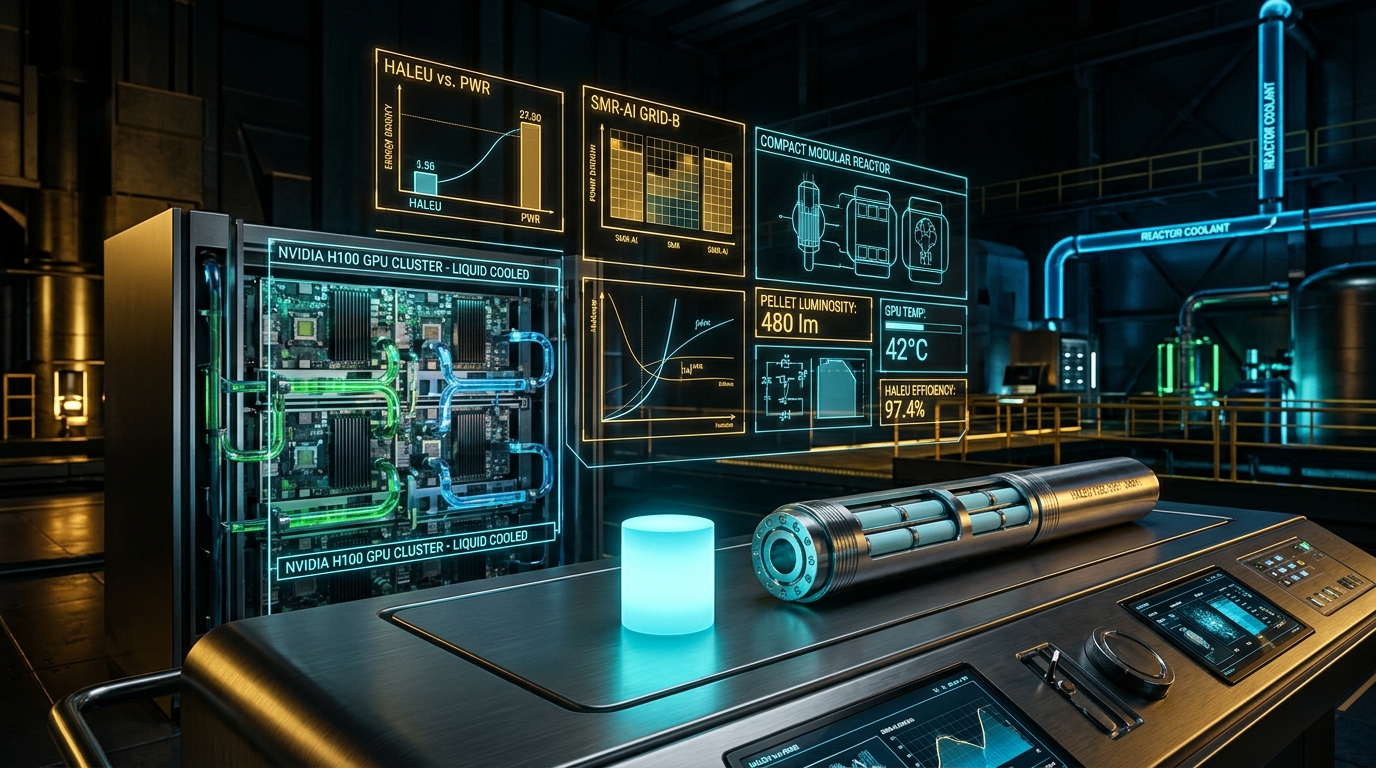
The sharpest bottleneck lies in the very Small Modular Reactors (SMRs) contracted by AI hyperscalers (such as Amazon-backed X-energy and Bill Gates-backed TerraPower). Whereas conventional light-water reactors run on uranium enriched to 3% to 5% $\text{U-235}$ (*LEU*), the majority of Generation IV advanced SMR designs require HALEU (*High-Assay Low-Enriched Uranium*), enriched between 5% and 19.75% $\text{U-235}$. Until 2024, the sole commercial-scale supplier of HALEU on Earth was Rosatom's subsidiary (Tenex in Russia). Scaling domestic Western HALEU centrifuge cascades via Centrus Energy in Ohio and Urenco will require years and billions of dollars to reach the tens of metric tons annually demanded by planned SMR fleets.
---
V. Conclusion: The Joule–Silicon Standard and the New Sovereignty of Nations
The convergence of the Artificial Intelligence revolution and the nuclear renaissance permanently ends the era in which macroeconomics could be divorced from physical engineering. The 21st century is witnessing the birth of a new metric of national power — the Joule–Silicon Standard:
$$\text{Effective Sovereign Power} = (\text{Firm Baseload Capacity in GW}) \times (\text{Lithographic Efficiency in nm}) \times (\text{Resource Autonomy})$$
For resource-rich emerging powers — particularly Brazil (which holds the world's 7th largest geological uranium reserve, with less than 30% of its territory deeply surveyed, alongside indigenous ultracentrifuge enrichment mastery developed by Indústrias Nucleares do Brasil and the Brazilian Navy) and African producers such as Namibia and Niger — the strategic imperative is unmistakable: exporting cheap raw mineral ore only to import expensive cloud compute and AI subscriptions would replicate the colonial division of labor of the 19th century.
The nations and corporations that simultaneously master the enriched uranium fuel cycle, modular baseload reactor engineering, and sovereign AI data centers will dictate the terms of productivity, defense, and monetary stability over the next fifty years.
Fontes & Referências Documentais
- International Energy Agency (IEA) (2025). "Electricity 2025–2026: Analysis and Forecast to 2030 — The Surge of AI Data Centers and Nuclear Baseload". IEA Publications, Paris.
- World Nuclear Association (WNA) (2024). "The Nuclear Fuel Report: Global Scenarios for Demand and Supply Availability 2023–2040". World Nuclear Association London.
- Smil, Vaclav (2015). "Power Density: A Key to Understanding Energy Sources and Uses". MIT Press.
- U.S. Department of Energy (DOE) (2024). "Pathways to Commercial Liftoff: Advanced Nuclear and HALEU Fuel Cycle Infrastructure". U.S. Department of Energy Reports.
- Electric Power Research Institute (EPRI) (2024). "Powering Intelligence: Analyzing Artificial Intelligence and Data Center Energy Consumption". EPRI Technical Whitepaper.